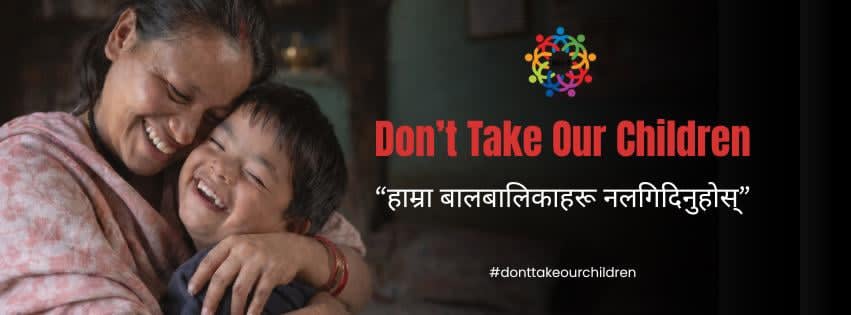
Bikalpa-Nepal supports the Don’t Take Our Children campaign
 Bikalpa-Nepal is an active member of The Inclusive Network.
The network is running the National Campaign Don’t Take Our Children.
We are a collective of parents, youth care leavers, and activists working towards the deinstitutionalisation of children. We seek to ensure that all children can access local services and support while respecting the sanctity of family life. The network advocates for solutions that enable children to grow up within their families and communities, rather than being separated from them.
Our focus is on securing these rights and opportunities for all children, both with and without disabilities, ensuring that every child receives the support they need in an inclusive, family-cantered environment.
The present campaign Don’t Take Our Children has focus on children with disabilities
This is because it is written in our new government’s manifesto the following:
“We will establish at least one state of the disability rehabilitation specialized resource centre in each province to ensure quality and integrated health services for citizens with disabilities. These centres will provide specialist services such as prosthetics and orthotics, assistive devices, physiotherapy, occupational therapy, and speech therapy under one roof. Additionally, modern laboratories will be set up for the production and maintenance of artificial limbs.”
While we welcome this promise to give more services to children with disabilities,we know similar efforts were made in Nepal before with serious pitfalls causing serious harm to children with disabilities.
Children with disabilities deserve to grow up in families, not institutions. With the right support, they can stay at home, go to school with their peers, and reach their full potential.
Nepal’s Children with Disabilities: A Short Story
Resource Classes are the most significant service given to children with disabilities in Nepal. These classes were started in the 1990s to help children with disabilities join local schools. The idea was that children would spend a short time in these classes, they would get assessed and a rehabilitation program would be made for them then they would return home and go to mainstream their local schools. But this did not happen. Instead, once children enter, they often stay for years. Today, over 8,000 children remain separated from their families.Conditions in many centres is extremely worrying. Children live in overcrowded rooms, often underfed, withdrawn, and without proper support. A study in 2023 found that teachers cannot meet the children’s needs, parents feel forced to send them because no alternatives exist, and children themselves say they want to go home. Resource Classes take money meant for local schools and use it to keep children apart.living in horrible, isolatedplaces, seeing their families at best once a year. Many have lost total contact with their families.
This system goes against children’s rights. International agreements like the Convention on the Rights of Persons with Disabilities and the Convention on the Rights of the Child say that children should grow up with their families, go to inclusive schools, and live in their communities. Nepal’s own laws also promise family care, protection from separation, and equal access to education.
One child in a Resource Class is the cost of 10 children in a local school. High cost, no learning, lasting harm……
Our Concerns
- New “Disability Rehabilitation Centres” may become residential facilities, repeating the same mistakes.
- Children should only receive services together with their families.
- The government must investigate the Resource Class system, especially the lack of financial transparency.
- Municipalities should be given the support and funds to provide local, community‑based services- this is what most children and most families want – it is not a dream- there a lot of examples that this can be done – making happier children and families.
Our Call!
Children with disabilities deserve to grow up in families, not institutions. With the right support, they can stay at home, go to school with their peers, and reach their full potential.